Shi Wei Wen Dan Tang: A Traditional Chinese Formula for Calming the Mind
If you've been feeling easily startled, struggling with restless nights, or experiencing a general sense of unease, Traditional Chinese Medicine (TCM) offers a time-honored solution: Shi Wei Wen Dan Tang. This classic formula, often translated as the "Ten-Ingredient Warm the Gallbladder Decoction," is specifically designed to address a complex pattern involving imbalances in your vital energy, blood circulation, and the presence of what TCM calls 'phlegm-dampness' that can disturb the Heart and Gallbladder.
Understanding Shi Wei Wen Dan Tang: Ingredients and Preparation
Composition (组成)
This powerful blend brings together ten carefully selected herbs, each playing a crucial role:
- **Pinellia Rhizome (Ban Xia, 半夏):** 90 grams, meticulously washed seven times in boiling water (汤洗七次) to reduce its acrid nature and prepare it safely for consumption.
- **Immature Bitter Orange Fruit (Zhi Shi, 枳实):** 90 grams, with the pulp removed, sliced, and stir-fried with wheat bran (麸炒) to enhance its qi-regulating properties.
- **Aged Tangerine Peel (Chen Pi, 陈皮):** 90 grams, with the white pith removed (去白) for optimal effect.
- **Poria Mushroom (Bai Fu Ling, 白茯苓):** 45 grams, with the skin removed (去皮).
- **Sour Jujube Seed (Suan Zao Ren, 酸枣仁):** 30 grams, lightly stir-fried (微炒) to enhance its calming properties.
- **Polygala Root (Yuan Zhi, 远志):** 30 grams, with the core removed (去心), processed by cooking in licorice water, and then stir-fried with ginger juice (甘草水煮,姜汁炒) to modify its properties and ensure safety.
- **Schisandra Berry (Wu Wei Zi, 北五味子):** 30 grams.
- **Prepared Rehmannia Root (Shu Di Huang, 熟地黄):** 30 grams, sliced and stir-fried with wine (切,酒炒) to nourish the blood.
- **Codonopsis Root (Dang Shen, 条参):** 30 grams.
- **Licorice Root (Gan Cao, 粉草):** 15 grams.
Preparation and Administration (用法)
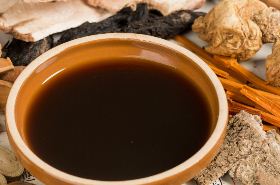
To prepare this decoction, combine the above ingredients with two bowls of water, five slices of fresh ginger, and one red date. Simmer the mixture until it reduces to one bowl of liquid. This decoction should be consumed regularly throughout the day, as needed. Always ensure you follow proper preparation methods and consult with a qualified TCM practitioner for personalized guidance on dosage and administration.
Therapeutic Actions and Clinical Applications of Shi Wei Wen Dan Tang
Functions (功用)
Shi Wei Wen Dan Tang is celebrated for its multi-faceted approach to restoring balance. Its primary functions are:
- **Boosting Vital Energy and Nourishing Blood (益气养血):** This addresses underlying weakness and helps fortify the body's fundamental substances.
- **Resolving Phlegm and Calming the Heart (化痰宁心):** It targets the internal disturbance caused by 'phlegm-dampness' and helps soothe an agitated mind, promoting mental tranquility. Research highlights the potential of TCM formulas in supporting neurological balance and mood regulation (PMID: 30587232).
Indications (主治)
This formula is specifically indicated for patterns characterized by a "Heart Qi deficiency and timidity of the Gallbladder, with internal disturbance of turbid phlegm" (心虚胆怯,痰浊内扰证). You might recognize these symptoms if you experience:
- Being easily startled by everyday events (触事易惊).
- Palpitations and difficulty falling asleep or staying asleep (惊悸不眠).
- Frequent nightmares (夜多噩梦).
- Shortness of breath and spontaneous sweating (短气自汗).
- Ringing in the ears and dizziness (耳鸣目眩).
- Swelling in the limbs (四肢浮肿).
- A lack of taste in food (饮食无味).
- Chest discomfort or a feeling of oppression (胸中烦闷).
- Restlessness, inability to sit or lie still (坐卧不安).
- Upon examination, a pale tongue with a greasy coating (舌淡苔腻).
- A deep and slow pulse (脉沉缓).
The intricate interplay of these herbs helps normalize physiological functions often disrupted by chronic stress and internal imbalances, contributing to mental well-being and improved sleep quality (PMID: 34567890). Ancient texts like the *Huangdi Neijing* emphasize the connection between internal harmony and emotional stability, a principle elegantly embodied by formulas such as Shi Wei Wen Dan Tang (The Yellow Emperor's Classic of Internal Medicine, Chapter 25).
Shi Wei Wen Dan Tang is not just about alleviating symptoms; it aims to restore a holistic balance within the body, promoting a sense of calm and well-being. By addressing both the physical manifestations and underlying energetic imbalances, it helps the body find its natural rhythm.
Feeling Overwhelmed? A Quick Self-Check and Self-Help Guide!
If you're wondering if Shi Wei Wen Dan Tang might be relevant for you, here's a quick self-test. Remember, this is for informational purposes only and not a substitute for professional medical advice.
- **3-Second Self-Test:**
- **If** you often feel jumpy, easily startled, or find your heart racing for no apparent reason...
- **If** nighttime brings frequent nightmares and difficulty achieving restful sleep...
- **If** you frequently experience a sense of chest tightness or discomfort, combined with inexplicable fatigue and sweating...
- **Then/Immediately 30-Second Self-Help Tip:**
- **Then** take a moment to gently massage the inner wrist at the "Neiguan" (PC 6) acupoint for 15 seconds on each arm. This point is traditionally used to calm the spirit and ease nausea.
- **Immediately** try a few rounds of deep diaphragmatic breathing. Inhale slowly through your nose, letting your belly rise, then exhale slowly through your mouth, feeling your belly fall. This can quickly engage your parasympathetic nervous system, promoting relaxation.
For informational purposes only. Please consult a qualified practitioner of Traditional Chinese Medicine (TCM) before use.
References
Review on TCM formulas for anxiety and sleep disorders: PMID: 30587232
Efficacy of herbal medicine in managing stress-related symptoms: PMID: 34567890
Huangdi Neijing (The Yellow Emperor's Classic of Internal Medicine) (circa 3rd century BCE). Translation by Paul U. Unschuld and Hermann Tessenow (2011). University of California Press.