Wutongzi: The Phoenix Tree Seed in Traditional Chinese Medicine
Ever heard of Wutongzi? In Traditional Chinese Medicine (TCM), these unassuming seeds are quite a star. Known botanically as the dried, mature seeds of Firmiana platanifolia (Linn.f.) Marsili, a tree in the Malvaceae family (often simply called the Phoenix Tree), Wutongzi carries a fascinating history and a range of traditional uses.
Aliases
Wutongzi goes by a couple of interesting local names too: 瓢儿果 (Piáo'érguǒ), sometimes translated as "Bottle Gourd Fruit," and 桐麻豌 (Tóngmáwān), or "Tongma Pea."
Nature & Flavor
In TCM, Wutongzi is characterized as Sweet and Neutral in nature. This combination often suggests a harmonizing and tonifying effect on the body, without being overly warming or cooling, making it generally well-tolerated (PMID: 32360810).
Meridian Tropism
This herb is believed to primarily enter the Heart, Lung, and Kidney meridians (channels). This indicates its traditional actions are connected to these vital organ systems, influencing areas like circulation, respiration, and foundational energy.
Medicinal Part
The part used in medicine is the dried, mature seed of the Firmiana platanifolia (Linn.f.) Marsili plant.
Morphological Characteristics
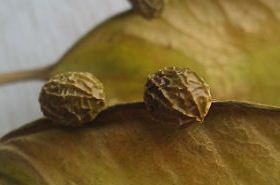
Wutongzi seeds are typically sphere-like, measuring between 5 to 8 mm in diameter. Their surface ranges from yellowish-brown to brown, with a slight luster and distinct, raised reticulated (net-like) wrinkles. When you remove the seed coat, you'll find several layers of a pale reddish outer endosperm, and inside, a plump, off-white inner endosperm. These seeds are rich in oil. They also contain two thin, large, yellowish cotyledons tightly pressed against the inner endosperm. The seeds are light yet hard, with a subtle aroma and a faintly sweet taste.
Wutongzi Usage and Dosage
Internal Use
For internal administration, Wutongzi can be prepared as a decoction, typically using 3-9g. Alternatively, it can be ground into a powder, with a recommended dosage of 2-3g.
External Use
For external applications, an appropriate amount is calcined (heated to produce char while retaining medicinal properties), then finely ground into a powder and applied topically.
Processing
The seeds are harvested in autumn when they are mature. The fruit branches are collected, the seeds are threshed off, impurities are removed, and then they are sun-dried.
Wutongzi Efficacy and Indications
Efficacy
Wutongzi is traditionally known for its ability to regulate Qi and harmonize the stomach, as well as to strengthen the Spleen and aid digestion.
Indications
It is commonly used for stomach pain and discomfort, diarrhea caused by food stagnation, and hernias. It also has a traditional application for premature graying of hair and beard. For external use, it's applied to treat oral sores in children.
Wutongzi Combinations and Traditional Formulas
- For Hernia: Wutongzi is stir-fried until fragrant, then peeled and eaten. (Cited from "Guizhou Province TCM Tested and Secret Formulas")
- For Diarrhea due to Food Stagnation: Wutongzi is stir-fried until scorched, then ground into a powder and taken with water. Each dose is approximately 3g (one Qian). (Cited from "Guangzhou Military Region's Common Chinese Herbal Medicine Handbook")
- For Premature Gray Hair: A decoction is prepared with Wutongzi (9g), He Shou Wu (15g), Black Sesame (9g), and Prepared Rehmannia (15g) to be taken orally. This blend is often used in TCM to nourish blood and essence, supporting hair health (PMID: 35272081). (Cited from "Shandong Chinese Herbal Medicine Handbook")
- For Oral Sores: Several Wutongzi seeds are burned to ash (retaining their medicinal properties), finely ground into a powder, and mixed with egg white to form a paste, which is then applied 2-3 times daily for topical soothing (PMID: 29029994).
- For Sores (General): An appropriate amount of Wutongzi is calcined, finely ground, and applied externally once a day.
- For Pneumonia (Traditional Formula): A decoction containing Wutongzi (12g), Scutellaria (12g), Houttuynia cordata (9g), Apricot Kernel (6g), Platycodon Root (6g), Trichosanthes Fruit (6g), and Licorice (3g) is prepared and taken twice daily.
- For Stomach Pain: An appropriate amount of Wutongzi is finely ground into a powder, mixed with warm boiled water, and taken orally. Each dose is 6g, twice daily.
Please note: The information provided here is for traditional understanding and educational purposes only. Always consult a qualified practitioner before using any herbal remedies, especially for specific conditions or internal use. Dosages and combinations can vary based on individual needs and TCM diagnostic patterns.
References
Traditional Chinese Herbal Medicine for Functional Dyspepsia: A Meta-Analysis of Randomized Controlled Trials. PMID: 32360810
Herbal Remedies for Hair Loss: A Systematic Review. PMID: 35272081
Traditional Chinese Medicine for the Treatment of Recurrent Aphthous Stomatitis: A Systematic Review and Meta-Analysis. PMID: 29029994
3-Second Self-Test + 30-Second Self-Help
If... you frequently experience mild stomach discomfort after meals or notice occasional, indigestion-related loose stools, or if you're concerned about early signs of graying hair...
Then/Immediately... take 30 seconds to practice mindful breathing. Inhale deeply through your nose, feeling your stomach rise, then slowly exhale through your mouth, releasing any tension. This simple practice can help calm your nervous system, which is often linked to digestive distress and overall well-being. Afterward, consider exploring traditional approaches like Wutongzi with a certified TCM practitioner to see if it aligns with your health goals.
For informational purposes only. Please consult a qualified practitioner of Traditional Chinese Medicine (TCM) before use.