Chen Pi (Dried Tangerine Peel)
Alternate Name: Jupi (Tangerine Peel).
Flavor and Nature: Bitter, Pungent, Warm.
Meridian Affinity: Lung, Spleen.
Medicinal Part: The dried mature pericarp of the plant.
Morphological Characteristics:
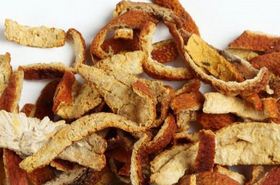
1. Chen Pi: Often peeled into several lobes, connected at the base, some appearing as irregular flakes, 1-4mm thick. The outer surface is orange-red or reddish-brown, with fine wrinkles and sunken, punctate oil glands. The inner surface is pale yellowish-white, rough, with yellowish-white or yellowish-brown reticulated vascular bundles attached. The texture is slightly hard and brittle. It has an aromatic fragrance and a pungent, bitter taste.
2. Guang Chen Pi (Canton Tangerine Peel): Typically connected in 3 lobes, with a neat shape and uniform thickness, about 1mm. The punctate oil glands are larger and appear clear and transparent when viewed against light. The texture is relatively soft.
Dosage and Preparation of Chen Pi
Dosage: 3-10g.
Preparation: Remove impurities, spray with water, moisten thoroughly, cut into shreds, and dry.
Functions and Actions of Chen Pi
Functions: Regulates Qi and invigorates the Spleen, dries dampness and resolves phlegm. [Many studies highlight the broad therapeutic potential of citrus peels, including Chen Pi, through their rich bioactive compounds. PMID: 33745914]
Indications: Primarily used for abdominal fullness and distension, reduced appetite with nausea or vomiting and diarrhea, and cough with copious phlegm.
Contraindications and Precautions for Chen Pi
This herb is pungent and dispersing, bitter and drying, and its warm nature can contribute to heat. Therefore, it should be used with caution in individuals with a red tongue and scanty fluids, or those with internal excess heat. It is also advised to use with caution for individuals with Qi deficiency and a dry constitution, Yin deficiency with dry cough, hemoptysis (coughing up blood), or internal excess heat. Always consult a healthcare professional before use, especially if you have pre-existing conditions.
Herbal Combinations with Chen Pi
1. When combined with Cang Zhu (Atractylodes Rhizome) and Hou Po (Magnolia Bark), it is used for individuals with cold-dampness and Qi stagnation in the Middle Jiao (digestive center), manifesting as abdominal distension and pain, nausea, vomiting, and diarrhea.
2. When combined with Shan Zha (Hawthorn Fruit) and Shen Qu (Medicated Leaven), it is used for food stagnation and Qi stagnation, presenting as abdominal distension and pain.
3. When combined with Zhi Shi (Immature Bitter Orange) and Sheng Jiang (Fresh Ginger), it is used for chest impediment (Bi Syndrome) with stuffiness in the chest and shortness of breath.
Traditional Formulas Featuring Chen Pi
① To treat cholera with vomiting: Chen Pi (Dried Tangerine Peel) 3 qian, Huo Xiang (Agastache) 2 qian. For cold-type conditions, add Gan Jiang (Dried Ginger), Sha Ren (Amomum Fruit) 1.5 qian each; for heat-type conditions, add Huang Lian (Coptis Rhizome), Huang Qin (Scutellaria Root), Hua Shi (Talcum) 1.5 qian each. Decoct with water and take. (From Bencao Huiyan)
② To treat disharmony of Spleen and Stomach, sudden onset of cold-Qi disruption, where cold causes Qi to gather and stagnate, leading to distension and fullness, with a taut and slow pulse (Kuan Zhong Wan from Jifeng Puji Fang): Huang Ju Pi (Yellow Tangerine Peel) 4 liang, Bai Zhu (Atractylodes Macrocephala Rhizome) 2 liang. Grind into a fine powder; mix with wine paste and form into pills the size of parasol tree seeds. Take 30 pills with Muxiang (Costus Root) decoction before meals.
③ To treat deficiency of original Qi, indigestion, or disharmony of Zang-Fu organs with epigastric distention and fullness (Jupi Zhizhu Wan from Lanshi Mizang): Ju Pi (Tangerine Peel), Zhi Shi (Immature Bitter Orange, stir-fried until yellow) 1 liang each, Bai Zhu (Atractylodes Macrocephala Rhizome) 2 liang. Grind into an extremely fine powder, mix with rice cooked in lotus leaf to form pills twice the size of mung beans. Take 50 pills with plain warm water, adjusting dosage based on the severity of the condition.
④ To treat diarrhea and dysentery: Chen Pi (Dried Tangerine Peel) 3 qian, Huo Xiang (Agastache) 2 qian. For deficiency-type, add Bai Zhu (Atractylodes Macrocephala Rhizome, stir-fried with earth) 3 qian, Fu Ling (Poria) 2 qian, Gan Cao (Licorice Root) 1 qian; for excess-type, add Zhi Shi (Immature Bitter Orange, stir-fried with bran) 3 qian, Hou Po (Magnolia Bark) 2 qian, Mu Xiang (Costus Root) 1 qian. Decoct with water and take. (From Bencao Huiyan)
⑤ To treat infantile Spleen malnutrition (Ganjí) with diarrhea (Yi Huang San from Youke Leicui): Chen Ju Pi (Aged Tangerine Peel) 1 liang, Qing Ju Pi (Green Tangerine Peel), He Zi Rou (Chebula Fruit), Gan Cao (Licorice Root, stir-fried) 0.5 liang each. Grind into a coarse powder. For each dose, take 2 qian, decoct with one cup of water until reduced to six-tenths, and take warm before meals.
⑥ To treat dry heaving, retching, and cold hands and feet (Jupi Tang from Yixin Fang, cited in Xiaopin Fang): Ju Pi (Tangerine Peel) 4 liang, Sheng Jiang (Fresh Ginger) 0.5 jin. Decoct these two ingredients with seven sheng of water until three sheng remain. Drink one sheng per dose.
⑦ To treat tapeworm (Jupi Wan from Waitai, cited in Fanwang Fang): Ju Pi (Tangerine Peel) 4 fen, Ya Zi (Areca Seed), Wu Yi (Sophora japonica fruit) 6 fen each. Pound and sift these three ingredients, then mix with honey to form pills the size of Wutong seeds. Take 30 pills with rice water, before meals, twice daily.
⑧ To treat postpartum urinary and fecal retention (Tongqi San from Jiyin Gangmu): Chen Pi (Dried Tangerine Peel), Su Ye (Perilla Leaf), Zhi Ke (Bitter Orange, stir-fried with bran), Mu Tong (Akebia Stem) equal parts. Cut into coarse pieces. For each dose, take 4 qian, decoct with water and take warm.
⑨ To treat severe bloody urine (Hematuria) (Tongmi San from Shiyi Dexiao Fang): Chen Pi (Dried Tangerine Peel), Xiang Fu Zi (Cyperus Rhizome), Chi Fu Ling (Red Poria) equal parts. Cut into coarse pieces. For each dose, take 3 qian, decoct with water and take on an empty stomach.
Classical Interpretations of Chen Pi
1. Ming Yi Bie Lu (Records of Famous Physicians): "Descends Qi, stops vomiting."
2. Bencao Gangmu (Compendium of Materia Medica): "Treats vomiting, retching, rebellious Qi with acid reflux, and occasional clear fluid regurgitation."
Benefits of Drinking Chen Pi Infusion
1. Soothes Cough with Excessive Phlegm
If you're dealing with a cough accompanied by a lot of phlegm, preparing an infusion with Chen Pi, fresh ginger, and walnuts, and then drinking it, can be quite effective in helping your body recover. [Research suggests that *Citrus reticulata* (Chen Pi) exhibits expectorant and antitussive properties, supporting its traditional use for coughs. PMID: 25164478]
2. Eases Stomach Pain
With today's fast-paced lifestyles, many people experience stomach pain due to irregular routines. In such cases, a Chen Pi infusion can help alleviate discomfort. Just prepare Chen Pi, fresh ginger, and brown sugar. Decoct the Chen Pi and ginger in water, then add a small amount of brown sugar and mix well before consuming.
3. Relieves Vomiting
You can prepare Chen Pi, rice, and ginger juice. Decoct the ginger juice and Chen Pi in water, or incorporate rice to make a porridge. This can effectively help treat episodes of vomiting.
4. Addresses Burns
For minor burns, you can also gently rub Chen Pi directly onto the affected area.
5. Supports Chronic Gastritis
Finely grind dried Chen Pi into a powder, add a small amount of white sugar, and then mix with warm water. Drink this on an empty stomach.
6. Manages Bronchitis
Infuse Chen Pi and garlic together in boiling water, then drink it as you would tea.
7. Boosts Appetite and Aids Digestion
Infuse dried Chen Pi and red dates in boiling water, cover, and let it steep for about ten minutes. It’s recommended to drink this before meals daily. Not only can it significantly enhance your appetite, but it also works wonders for indigestion.
8. Treats Cold with Cough
If you have a common cold accompanied by a cough, you can boil fresh Chen Pi in water, then add a small amount of white sugar and drink. This can help induce sweating and swiftly aid your recovery.
9. Promotes Beauty and Youthful Skin
Tangerine peel is packed with health-benefiting Vitamin C and essential oils. You can dry tangerine peels and steep them with tea leaves. This infusion not only refreshes your mind and promotes Qi circulation but also enhances the aroma. Furthermore, consuming Chen Pi helps expel toxins from the body, supporting the coordination of internal circulation, leading to clearer skin and a more radiant appearance.
10. Resolves Phlegm and Stops Cough
Chen Pi is a common Traditional Chinese Medicine herb. It is warm in nature and is excellent for regulating Qi, strengthening the Spleen, cutting grease, resolving phlegm, and stopping vomiting. If you experience cough with excessive phlegm, poor appetite, or digestive issues, drinking an appropriate amount of Chen Pi infusion can significantly promote your health. Chen Pi has a considerable impact on the Spleen and Stomach. It not only promotes gastrointestinal motility but also effectively eliminates accumulated gas in the intestines and acts as an expectorant and cough suppressant. Regular, moderate consumption can provide excellent health benefits. [The traditional uses, rich phytochemistry, and diverse pharmacological properties of *Citrus reticulata* (Chen Pi) are well-documented, making it a valuable herb in TCM. PMID: 34066060]
Precautions for Drinking Chen Pi Infusion
While Chen Pi infusion offers numerous benefits, incorrect usage can lead to side effects. Here are some important considerations:
1. Avoid Chen Pi if You Have Excessive Stomach Acid
While Chen Pi is known for strengthening the Spleen, regulating Qi, resolving phlegm, and easing coughs – often addressing symptoms like stomach pain or indigestion – it also has a drying quality. Therefore, if you're experiencing stomach fire, Qi deficiency, or a dry cough, it's best to limit or avoid excessive consumption to prevent your condition from worsening. For generally healthy individuals, once a week is usually sufficient; certainly, avoid overdoing it.
2. Do Not Consume Chen Pi Infusion While Taking Medication
Experts advise that Chen Pi can influence drug-metabolizing enzymes. Therefore, if you are currently on medication and wish to drink Chen Pi infusion, it's crucial to consult your doctor beforehand to avoid potential interactions that could affect medication efficacy or cause adverse effects.
3. Pregnant Women Should Exercise Caution with Chen Pi Infusion
Pregnancy is a very special period where consumed foods impact both the mother's health and fetal development. Many pregnant women wonder if they can consume Chen Pi. Chen Pi is excellent for harmonizing the middle jiao, stimulating appetite, resolving phlegm, and drying dampness, making it beneficial for conditions like cough with excessive phlegm, nausea, abdominal distension, or poor appetite.
However, if a pregnant woman has a constitution of Qi deficiency with dryness or Yin deficiency with dry cough, especially if accompanied by internal excess heat or hemoptysis, it is strongly advised to avoid Chen Pi to prevent negative impacts on both mother and fetus.
If a pregnant woman absolutely needs to consume Chen Pi, it must be done according to specific circumstances and methods, such as:
1. In early pregnancy, many women experience morning sickness. If the issue is severe, simply smelling Chen Pi or consuming small amounts of Chen Pi-infused foods can help control vomiting.
2. If a pregnant woman has a poor appetite, adding a small amount of Chen Pi to food can not only stimulate appetite but also aid digestion.
3. For individuals with a Yin deficient constitution, it's generally best to avoid Chen Pi, as it can worsen Yin deficiency.
4. Pregnant women can make Chen Pi and rice porridge, which is not only aromatic and refreshing but also beneficial for health.
Quick Self-Check & Immediate Relief (3-Second Test + 30-Second Fix)
If you frequently feel bloated or have a heavy, phlegmy cough, try brewing a simple Chen Pi tea with a slice of fresh ginger. This warming concoction can immediately help move things along and soothe your respiratory system. If you find yourself constantly reaching for antacids due to indigestion, try adding a pinch of dried Chen Pi powder to warm water before meals; it often helps kickstart digestion.
For informational purposes only. Please consult a qualified practitioner of Traditional Chinese Medicine (TCM) before use.