Centipede
In the vast landscape of Traditional Chinese Medicine (TCM), many intriguing ingredients are utilized for their potent therapeutic properties. Among them is Centipede (Scolopendra subspinipes mutilans), a fascinating herb known for its powerful actions in addressing a range of complex conditions. Let's delve into what makes this unique ingredient a cornerstone in specific TCM formulations.
Properties and Flavor Profile
Centipede is characterized by its spicy (辛) flavor and warm (温) nature. These qualities are key indicators of its therapeutic direction in TCM, suggesting its ability to disperse, invigorate, and warm.
Meridian Affinity
In TCM, Centipede primarily enters the Liver Meridian (归肝经). This affinity explains its strong connection to conditions affecting neurological function, muscles, and tendons, as the Liver is responsible for smooth flow of Qi and blood, and governs the sinews.
Medicinal Part
The medicinal part used is the dried body of the centipede species Scolopendra subspinipes mutilans, a specific type of centipede belonging to the Scolopendridae family.
Morphological Characteristics
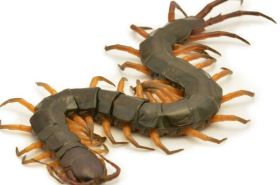
This medicinal herb typically presents as a flattened, elongated strip, ranging from 9 to 15 cm in length and 0.5 to 1 cm in width. It comprises a distinct head and a segmented trunk, totaling 22 segments. The head, dark red or reddish-brown with a slight sheen, is covered by a nearly circular head plate that subtly protrudes at the front. A pair of maxillae is attached to its sides, alongside a pair of antennae extending from the front. The trunk's first dorsal plate matches the head in color, while the subsequent 20 dorsal plates exhibit a brownish-green or dark green hue, also glossy. Interestingly, from the fourth to the twentieth dorsal plate, two subtle longitudinal grooves are often visible. The abdomen, pale yellow or brownish-yellow, appears shriveled. Starting from the second segment, each side features a pair of walking legs, which are typically yellow or reddish-brown, sometimes yellowish-white, and distinctively hook-shaped. The very last pair of legs is notably tail-like, earning them the moniker 'caudal legs,' and they are quite prone to detachment. The herb's texture is brittle, and its cross-section often shows fissures. It emits a faintly fishy yet uniquely pungent odor, and its taste is spicy with a touch of saltiness.
Centipede Dosage and Preparation
Dosage
The typical dosage for Centipede in Traditional Chinese Medicine is 3 to 5 grams. However, this is a potent ingredient, and exact dosages should always be determined by a qualified TCM practitioner.
Preparation Method
The preparation process involves carefully removing any attached bamboo leaves, thoroughly washing the centipede, then baking it over a low fire until it turns slightly yellow. Finally, it is cut into manageable segments for medicinal use. This crucial processing helps to reduce its toxicity and enhance its therapeutic efficacy.
Centipede: Therapeutic Actions and Indications
Key Actions
- Calms internal wind and suppresses spasms (息风镇痉): This is its primary action, making it highly effective for neurological disturbances.
- Unblocks meridians and alleviates pain (通络止痛): It helps to improve circulation and reduce pain, particularly in conditions involving stagnation.
- Dispels toxins and resolves lumps/nodules (攻毒散结): Centipede is used for its ability to counteract toxic influences and break down abnormal growths or swelling.
Primary Indications
Centipede is traditionally used for a broad spectrum of conditions, including:
- Internal stirring of Liver Wind (肝风内动): Manifesting as neurological symptoms like tremors and involuntary movements.
- Spasms and convulsions (痉挛抽搐): Including generalized body spasms.
- Infantile seizures (小儿惊风): A common application in pediatric TCM for acute convulsive disorders.
- Facial paralysis following a stroke (中风口?): Often part of a broader treatment strategy for post-stroke recovery.
- Hemiplegia (半身不遂): Paralysis affecting one side of the body.
- Tetanus (破伤风): Due to its strong anti-spasmodic properties.
- Stubborn rheumatic pain (风湿顽痹): Especially when characterized by severe, fixed pain.
- Migraines and headaches (偏正头痛): Particularly those with a strong wind component.
- Sores and skin ulcers (疮疡): Applied topically or internally to address toxic accumulations.
- Scrofula (瘰疬): Chronic swelling of lymph nodes, often in the neck.
- Snake and insect bites (蛇虫咬伤): Used to counteract venom and reduce inflammation.
Research has shown that components of *Scolopendra subspinipes mutilans* possess significant analgesic and anti-inflammatory properties, supporting its traditional use for pain relief and swelling reduction. PMID: 33503597
Traditional Centipede Combinations
Centipede is often combined with other herbs to enhance its effects and tailor its actions to specific conditions. Here are a couple of traditional examples:
1. For Severe Infantile Convulsions (天吊惊风)
For severe infantile convulsions where the eyes are rolled upwards showing only the whites, accompanied by opisthotonus (severe arching of the back, with head and heels bent backward), and an inability to vocalize, the formula 'Shuang Jin San' (Double Gold Powder) is traditionally indicated. This preparation involves taking one large centipede, removing its head and feet, and roasting it with butter or lard. It is then carefully split open with a bamboo knife, ensuring to note the left and right sides. Separately, approximately 3.7 grams of musk is also divided and marked for left and right. Both are ground into fine powders and packaged distinctly. For administration, a small amount of the left-side powder is gently blown into the child's left nostril, and similarly, the right-side powder into the right nostril. Caution is advised against excessive use. If the child's eyes have not returned to a normal position, a small additional amount may be administered until they do. (From《直指方》 - Zhi Zhi Fang)
2. For Women's Toe Sores (女人趾疮)
For persistent toe sores in women where inflamed, 'proud flesh' protrudes from beneath the nail and resists healing, a traditional approach is to roast one centipede, grind it into a powder, and apply it directly to the affected area. Additionally, *Rhizoma Arisaematis* (Nan Xing) powder mixed with vinegar is applied externally around the sore to further support healing. (From《医方摘要》 - Yi Fang Zhai Yao)
Modern scientific inquiry has also explored the neuroprotective potential of centipede extracts, which may contribute to its efficacy in managing conditions like convulsions and post-stroke complications. PMID: 14698522
Centipede Contraindications
IMPORTANT SAFETY WARNING: Due to its potent nature and potential for toxicity, Centipede is strictly contraindicated for pregnant women (孕妇禁用). Its strong moving and dispersing actions could potentially lead to adverse effects. Always consult a qualified Traditional Chinese Medicine practitioner before considering the use of Centipede or any other potent herbal remedy.
Classical Discussions on Centipede
The therapeutic uses of Centipede have been extensively documented in classical TCM texts, highlighting its long history and recognized efficacy:
- 《本草纲目》 (Bencao Gangmu - Compendium of Materia Medica): "Effective for infantile epilepsy and convulsions, neonatal tetanus with lockjaw, erysipelas (skin infection), tinea capitis (scalp fungal infection), scrofula, and snake bites."
- 《本草从新》 (Bencao Congxin - New Compendium of Materia Medica): "It is highly mobile and excels at dispersing pathogenic factors. It effectively treats neonatal tetanus with lockjaw."
- 《本经》 (Shennong Benjing - The Divine Farmer's Materia Medica): "Addresses malignant influences and 'Gu' poisoning (a severe form of toxic syndrome). It counters various toxins from snakes, insects, and fish. It dispels malevolent entities, treats persistent malarial fevers, and eliminates intestinal parasites."
Recent studies also investigate the anti-cancer potential of centipede and its components, aligning with its traditional action of "dispelling toxins and resolving lumps." PMID: 37113110
Quick Self-Check & Wellness Tips
If you're experiencing occasional muscle twitching or stiffness (3-second self-test)... then immediately try gentle stretching or apply a warm compress on the affected area for 30 seconds to promote relaxation. While Centipede is a powerful remedy for severe conditions, these simple steps can often bring relief for minor discomforts.
For informational purposes only. Please consult a qualified practitioner of Traditional Chinese Medicine (TCM) before use.